Music Guide – Götterdämmerung
Wagner's operatic works hold many musical secrets, including Götterdämmerung:
- What question is woven into the weaving of fate motif?
- In what way does Brünnhilde love differently than Siegfried?
- What is Hagen suffering from?
The Götterdämmerung music guide provides answers. A brief synopsis
for each scene provides an immediate overview. Leitmotifs and the
musical design of the work are clearly explained using musical score examples.
With the help of the
audio examples, the explanations are easy to follow.
Scope
- 60 pages
- 39 musical and audio examples, playable in the browser on smartphone or PC
Sample Reading
Just as Siegfried is portrayed as a differentiated character, Hagen is not simply evil either, as we learn from the prelude to Act II. The curtain opens, and we find the sleeping Hagen still in the Gibichung hall. Alberich appears to him in a nightmare: I hear thee, baleful dwarf. Hagen wrestles with his fate, and we learn what the yearning theme from this prelude is all about:
 Example 32: Hagen's Lament for Love. First, the woman's worth motif is heard. It is followed by Hagen's lament for love with the hate motifs in the background. The woman's worth motif is harmonically distorted at the point where she succumbed to your craft. The audio recording is therefore extended beyond the musical score example up to his words: prematurely aged, pale and wan, I hate the happy, never know joy. There, the woman's worth motif, beginning with the tremolos, emerges clearly.
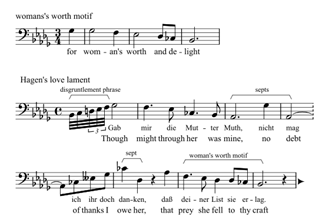
In Hagen's lament music, upward and downward striking sevenths occur, symbols of (missing) love. The woman's worth motif also appears.
Alberich has embedded himself in Hagen's thought world. Both seek to ruin Siegfried. A new motif appears, symbolizing the planned murder of Siegfried:
Example 33:
Derivation of the Murder Motif. In the recording, we first hear the renunciation motif, Hagen's lament for love, and the murder motif, each as shown in the musical score example. This is followed by a sequence from the scene between Alberich and Hagen featuring the complete murder motif.
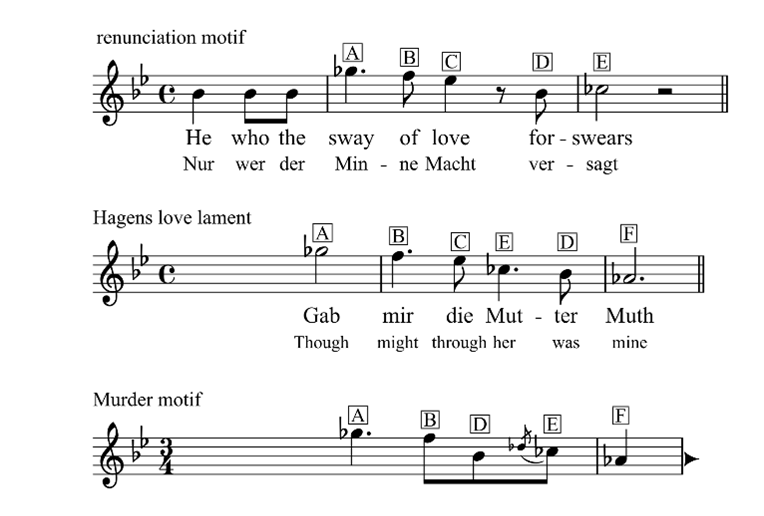
Thus, the thought of murder can be musically explained by Hagen's lack of love.
At dawn, the elf vanishes and the sun rises. (...)
Examples
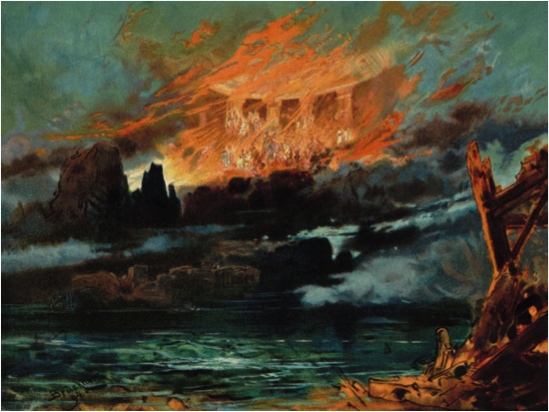
To listen to all audio examples recorded so far, click on the image
- World greeting Siegfried
- World greeting Norns
- Der. fate weaving motif
- Valhalla motif
- Contract motif
- Complete fate motif
- Twilight of the gods motif
- Loge motif
- Rhine gold motifs
- Der. sword motif
- Tearing rope
- Der. hero theme
- Der. Brünnhilde motiv
- Der. hero love motif
- Siegfried motif
- Valkyrie motif
- Der. freedom motif
- Der. Hagen motif
- Gibichungs’ motif
- Magic fire and wood bird motifs
- Seduction motif
- Gutrune motif
- Enchantment scene
- Camouflage helmet motif
- Atonement motif
- Hagen's watch
- Der. disaster motif
- Disaster motif
- Overpowering Brünnhilde
- Hate motif
- Fidelity motif
- Hagen's love lament
- Der. murder motif
- Der. Wedding call
- Revenge union motif
- Rhine daughters’ play motif
- Death mourning motif
- Redemption motif
- Final music