Music Guide – Siegfried
Wagner's operatic works hold many musical secrets, including Siegfried:
- How is Siegfried's maturation into manhood reflected in his motifs?
- Why are the forest bird and the Rhinemaidens musically related?
- What message lies within the world inheritance motif?
The Siegfried music guide provides answers. A brief synopsis
for each scene provides an immediate overview. Leitmotifs and the
musical design of the work are clearly explained using musical score examples.
With the help of the
audio examples, the explanations are easy to follow.
Scope
- 56 pages
- 42 musical and audio examples, playable in the browser on smartphone or PC
Sample Reading
Mime had tried without success to patch the sword in the conventional way. Siegfried casts aside all conventions of the art of smithing: the revolutionary shatters the sword into its basic substance in order to cast it into a new form. He christens the sword with its old name, Nothung:
 Example 24: Nothung Motif
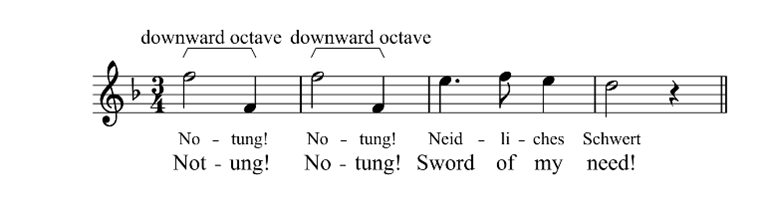
The Nothung motif is defined by falling octaves ("exclamation marks"), which are also a component of the sword motif.
The traditional form is replaced; the substance and name of the sword—symbols for soul and destiny—remain intact. Then Siegfried ignites a massive fire and melts down the fragments. The forging song is shaped by the falling lines of the wanderlust motif:
Example 25:
Derivation of the Forging Song. In the audio example, the freedom sequences of the wanderlust motif are first played in their original form and then in the rhythm of the forging song. This is followed by the forging song.
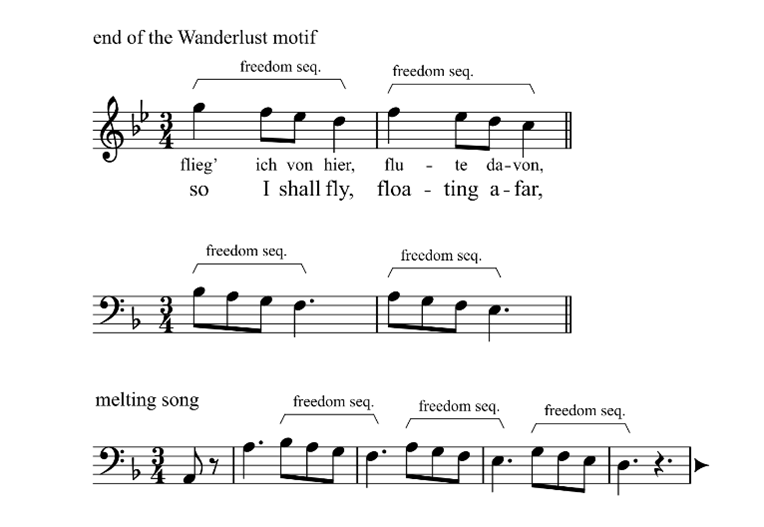
The motif essentially consists of the freedom sequences of the wanderlust motif. To Siegfried, the sword is a symbol of freedom. Armed with it, he intends to finally leave Mime behind. Unlike the work lust motif, numerous sequences are lined up here, each one step lower than the preceding sequence. As the metal melts down, the fragments musically collapse as well.
While Siegfried pours the molten metal into a new mold and forges the sword, Mime brews a sleeping potion with which he intends to kill Siegfried. (...)
Examples
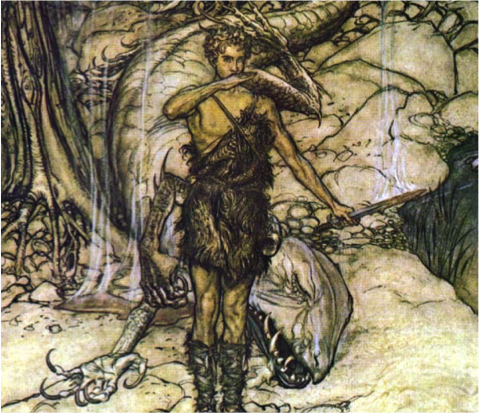
To listen to all audio examples, click on the image
- Deriv. brooding motif
- Mime's resentment
- Woe motif
- Forge motif
- Hoard motif
- Prelude Act I
- Sword motif
- Dragon motif
- Horn motif
- Siegfried motif
- Siegfried motif Act III
- Rumbling motif
- Deriv. Mime motif
- Mime's educational song
- Siegfried's longing for love
- Volsung motif
- Volsung woe & Sieglinde
- Wanderlust
- Wanderer motif
- Spear motif
- Mime's fear
- Deriv. slumber motif
- Work lust motif
- Nothung motif
- Forging song
- Deriv. Fafner motif
- Curse motif
- Hate motif
- Forest murmurs motif
- Forest bird motif
- Erda motif
- Twilight of the gods motif
- Resentment motif
- Ride motif
- Sleep motif
- Fate motif
- World inheritance motif
- Love ban motif
- Love confusion motif
- World greeting motif
- Love greeting motif
- Love bond motif