Music Guide – Die Walküre
Wagner's operatic works hold many musical secrets, including Die Walküre:
- How is the struggle against Wotan's regime reflected in the music?
- Is Wotan in love with his own daughter?
- What message does the redemption motif hold?
The Die Walküre music guide provides answers. A brief synopsis
for each scene provides an immediate overview. Leitmotifs and the
musical design of the work are clearly explained using musical score examples.
With the help of the
audio examples, the explanations are easy to follow.
Scope
- 56 pages
- 36 musical and audio examples, playable in the browser on smartphone or PC
Sample Reading
The third motif assigned to the Valkyries, the Valkyrie motif, is arguably the best-known motif of this opera:
 Example 20: Derivation of the
Valkyrie motif. In the audio example, we first hear the
becoming motif. Then the notes marked with ① to ③ are struck again.
Finally, the complete Valkyrie motif can be heard, which extends beyond the musical score example.
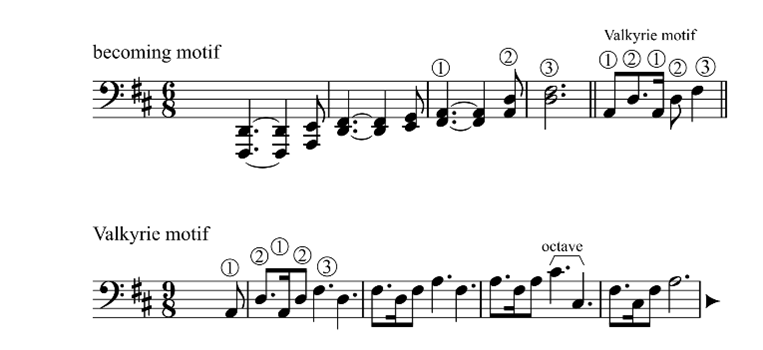
The Valkyrie motif in its original form consists of broken triads and is related to the becoming motif. The Valkyries are creatures of nature. Like the sword motif (Example 14), which is also related to the becoming motif, the Valkyrie motif contains a falling octave, underscoring the Valkyries' close bond with nature.
Alongside the original form, which begins with a broken major chord, the motif also appears—particularly in connection with Brünnhilde—in a sadder-sounding minor variant:
Example 21:
Valkyrie motif, major and minor variants
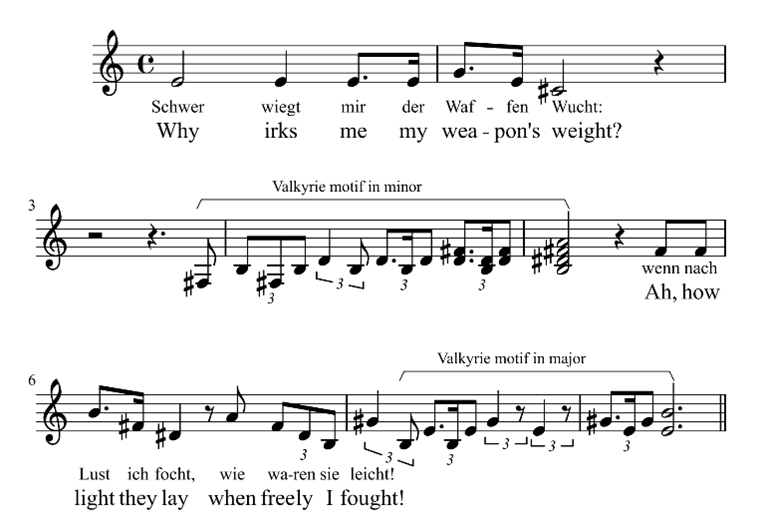
The two variants in major and minor trace the emotional state of the Valkyries. In the preludes to Acts II and III, we hear almost exclusively the positive major variant, expressing the Valkyries' joy in their genuine task. Brünnhilde is mostly accompanied by the minor variant.
After the curtain rises, we see Wotan and Brünnhilde on stage. Wotan instructs Brünnhilde to help Siegmund achieve victory in the fight against Hunding.
Then Fricka appears and Brünnhilde withdraws. (...)
Examples
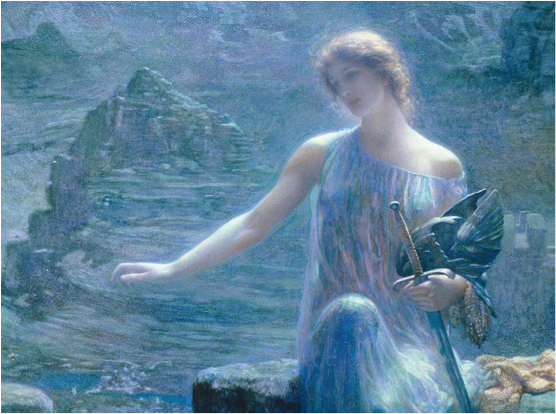
To listen to all audio examples, click on the image
- Storm motif
- Thunder motif
- Siegmund motif
- Siegmund and Sieglinde
- Sieglinde motif
- Sibling love motif
- Volsung woe motif
- Hunding motif
- Hunding's hospitality right
- Spear motif
- Valhalla motif
- Wehwalt motif
- Volsung motif
- Sword motif
- Love and spring song
- Renunciation motif
- Deriv. love distress motif Valkyrie
- Hojotoho motif
- Ride motif
- Valkyrie motif
- Valkyrie major and minor
- Wrath motif
- Resentment motif
- Despair motif
- Hate motif
- Rheingold fanfare
- Fate motif
- Announcement of death
- Siegfried motif
- Redemption motif
- Was it so disgraceful
- Volsung love motif
- Deriv. slumber motif
- Farewell greeting motif
- Sleep motif
- Magic fire motif